What 25 Museums in Turin and Genoa Reveal
This summer, Pollen LLC analyzed 25 museums in Turin and Genoa: what their buildings were, what they became, how many people visit, and how they pay their way.
The short version: most museums live in buildings that were never meant to be museums, and very few pay for themselves.
The research at a glance
| Measure | Finding |
|---|---|
| Museums studied | 25 (14 in Turin, 11 in Genoa) |
| In converted buildings | 80% (20 of 25) |
| Built new as museums | 20% (5 of 25) |
| Art museums | 64% (16 of 25) |
| Typical annual attendance | About 200,000 visitors (median) |
| Typical share of revenue earned | About 59% (median, nonprofit museums with published accounts) |
| Restoration funded by the operator | None of the documented cases |
What the buildings were, and what they became
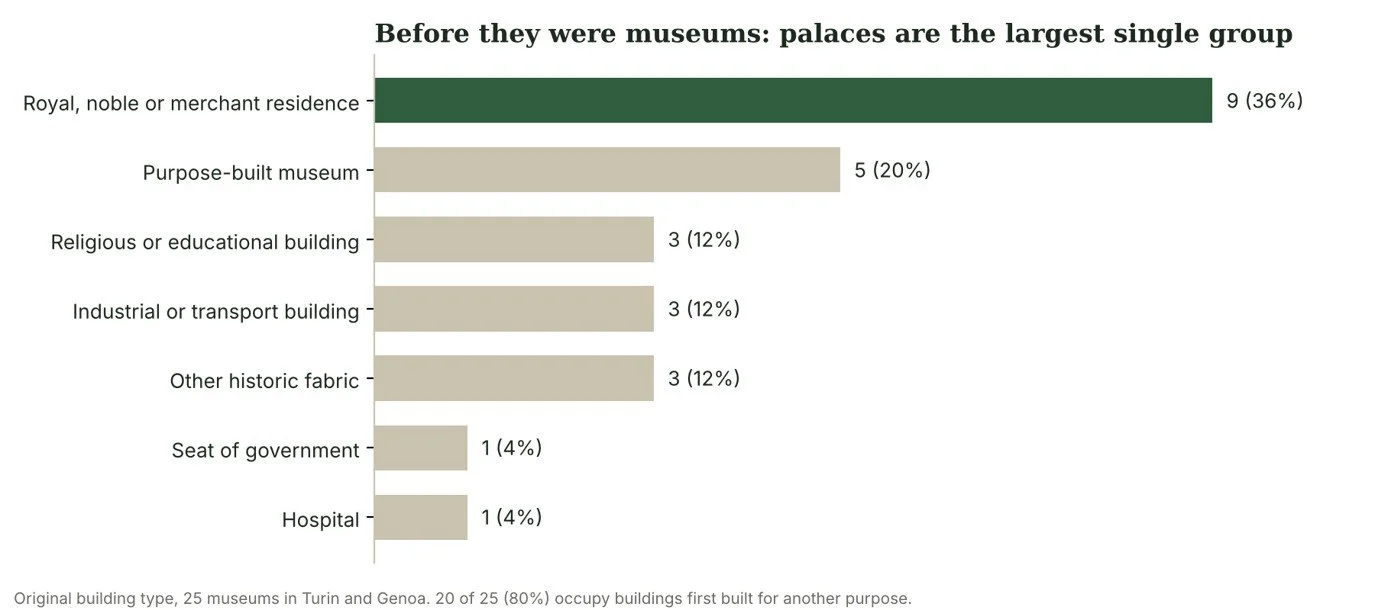
Former palaces are the largest single group: royal residences in Turin, banking-family palaces in Genoa. Almost all of them became art or historic-house museums, where the building itself is part of the exhibit.
The smaller groups are just as instructive. A synagogue became a cinema museum. A Jesuit college became one of the world's great Egyptian collections. A car factory and railway workshops became contemporary art and innovation venues.
Only 5 of the 25 museums were built new, and only one of those is an art museum. New construction mostly went to science, technology and an aquarium. Art moved into the palaces.
How these museums pay their way
Among the nonprofit museums that publish their accounts, the typical museum earns about 59% of its operating revenue from tickets, shops, events, rentals and sponsorship. The rest comes from public budgets, founding members and foundations.
The range is wide, from under 40% to over 80%. What separates them is not ticket prices; earned revenue per visit is similar across sites. It is cost. Large estates with gardens and grounds need far more support per visitor than a dense collection in a single building.
One pattern held in every case we documented: the money to restore the building came from outside the museum's operating budget. European Union funds, national recovery funds, banking foundations and tax-credit donations paid for the buildings. Ticket revenue paid for operations.
Five benchmarks for U.S. institutions
For a U.S. board, city or developer considering a cultural use for a historic building, the data points to five planning benchmarks.
1. Plan for contributed support from day one. A realistic base case earns roughly half to 60% of operating revenue. Treat projections above 75% with caution unless the collection is world-class.
2. Benchmark attendance against the median, not the headline. A few famous sites draw most of the visits. The typical museum draws far fewer.
3. Separate ownership from operation. The busiest museums we studied sit on public property but are run by independent foundations or consortia with their own boards and budgets.
4. Fund the building separately. Restoration capital should come from bonds, tax credits, preservation programs and foundations, not from projected ticket sales.
5. Match the building to the use. Palaces suit art and historic-house museums. Long-span industrial halls suit contemporary art, events and large objects. Estates with grounds carry the highest operating cost.
About the research
Pollen LLC conducted fieldwork at each site in July and August 2026 and reviewed published financial statements, government attendance statistics and regional tourism data. This is a case-study sample, so the findings describe patterns rather than rules. Site-level data is available to clients.
Working on a historic building project?
Pollen helps boards, cities and developers test whether a cultural use for a historic building is financially sustainable before they commit. We offer board briefings on these findings and feasibility reviews that benchmark a U.S. project against them.
© 2026 Pollen LLC. Sites referenced did not commission or review this analysis. Financial Sustainability Framework™ and Pollen Risk Indicator™ are trademarks of Pollen LLC.